Set lifetime, maintenance and replacements
Under Project settings → Economics, Lifetime and operating costs defines degradation assumptions and future expenses. These settings affect the multi-year economic assessment beyond the first-year results.
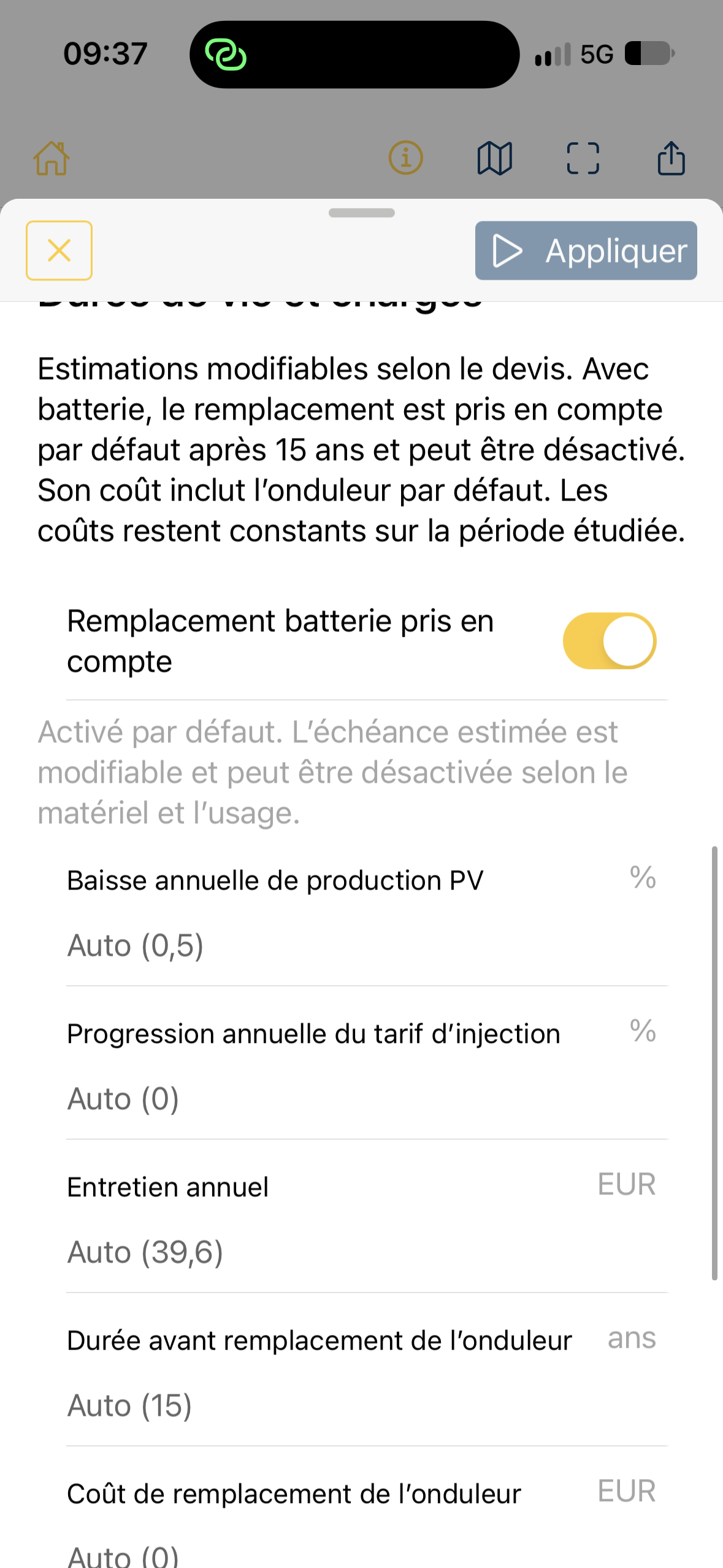
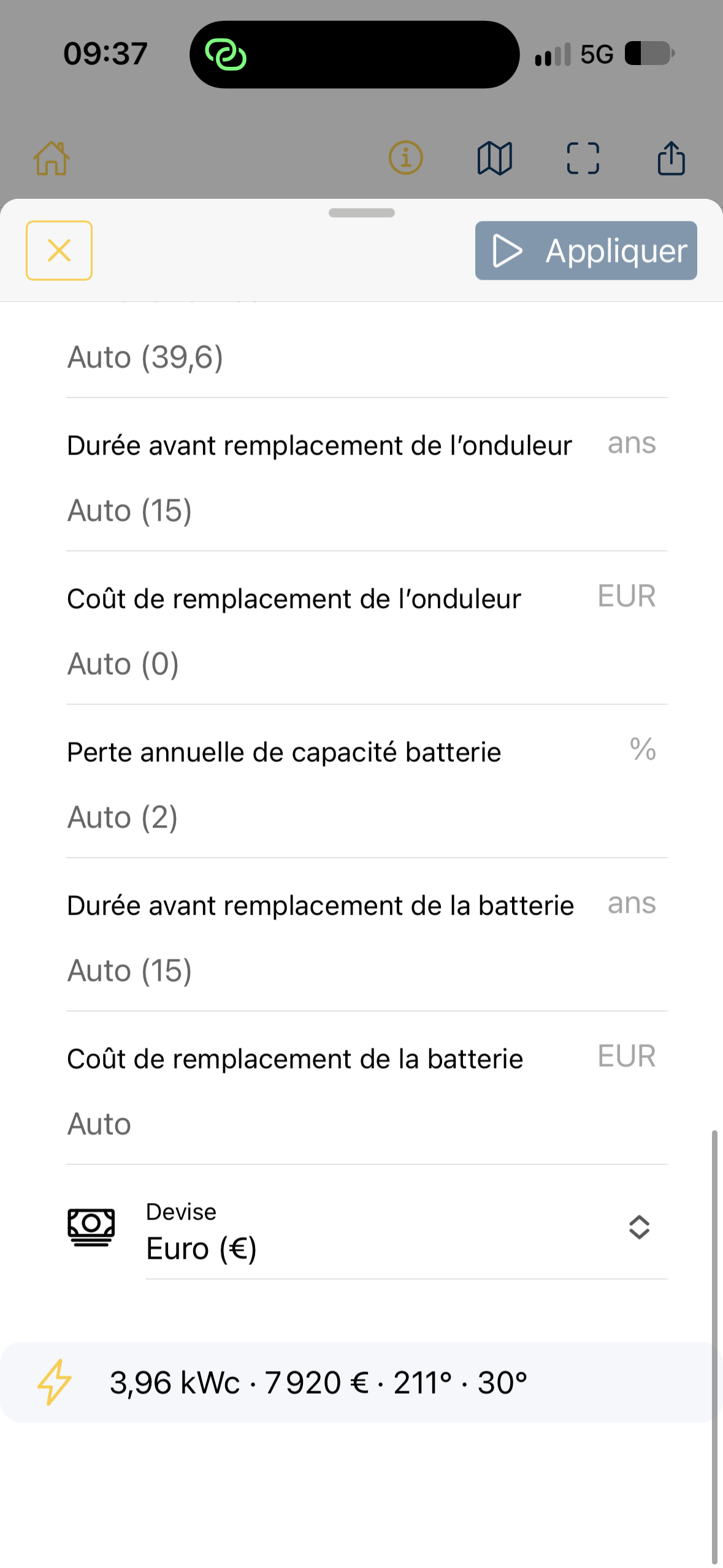
What do “Auto” values mean?
Section titled “What do “Auto” values mean?”When a field shows Auto (…) as a placeholder, Azimutis provides a calculated value or preset assumption. Enter another value to override it. Leaving the field blank retains the automatic behavior defined by the model.
“Auto” values are not lifetime predictions or manufacturer recommendations. Compare them with warranties, quotations and operating conditions.
Degradation and cost settings
Section titled “Degradation and cost settings”| Setting | Meaning | Automatic value used by Azimutis |
|---|---|---|
| Annual PV production decline | Annual degradation applied to PV production. | 0.5%/year |
| Annual export tariff escalation | Assumed change in the price paid for surplus exports. | 0%/year |
| Annual maintenance | Maintenance cost included each year. | 0.5% of installed PV cost, e.g. €39.60/year for €7,920 of PV. |
| Time to inverter replacement | Assumed time before inverter replacement. | 15 years |
| Inverter replacement cost | Expense allocated to inverter replacement. | 10% of PV cost without a battery; €0 with a battery, by default. |
| Annual battery capacity loss | Assumed decline in available capacity over time. | 2%/year |
| Time to battery replacement | Assumed replacement interval when enabled. | 15 years |
| Battery replacement cost | Expense included when a battery replacement is counted. | Installed battery cost by default. |
The last three settings appear only when the project includes a battery. Replacement cost and timing disappear when battery replacement is disabled.
These automatic values are actually used by the analysis engine when you do not enter other assumptions. They are defined in Azimutis calculations, not merely displayed in the interface. They remain simulation assumptions, not guaranteed values for every item of equipment.
Enable or disable battery replacement
Section titled “Enable or disable battery replacement”
With a battery, Include battery replacement is enabled by default. It controls whether replacement is included in the projection. When enabled, you can adjust time to replacement and replacement cost.
Replacement after 15 years is not a technical requirement for every battery. Actual lifetime depends on equipment, cycles, temperature and operating conditions. Disabling replacement sets its interval to 0: no battery replacement cost is included, and capacity continues to decline at the configured rate without resetting. This choice affects energy and cash flows and should be justified.
Inverter cost when a battery is included
Section titled “Inverter cost when a battery is included”The app’s help text explains that, under the automatic assumption, battery replacement cost includes the inverter by default. This is why automatic inverter replacement cost is €0 with a battery: it avoids counting the same expense twice.
Note: if you disable battery replacement while keeping automatic inverter cost at €0, the model includes no replacement cost for either item. Adjust the inverter assumption if it needs separate replacement.
For custom values, check what each cost includes. If your battery replacement quotation excludes the inverter, adjust both amounts accordingly.
How the calculations use these assumptions
Section titled “How the calculations use these assumptions”The engine calculates energy and cash flows for each year of the assessment:
- PV: production declines annually by
(1 − PV degradation rate)^(year − 1). At 0.5% per year, year two uses 99.5% of reference production; the reduction compounds. - Battery: usable capacity follows
(1 − capacity loss rate)^(battery age). At a scheduled replacement, battery age resets to zero. Without replacement, degradation continues. - Avoided electricity purchases: their value reflects annual changes in the grid electricity price.
- Surplus sales: revenue reflects annual changes in the export tariff.
- Maintenance: the annual cost is deducted from revenue each year.
- Replacements: the planned cost is deducted in the year replacement occurs.
Replacement timing: year 1 is the first operating year. A 15-year interval triggers replacement expenditure in year 16, after 15 elapsed years. Battery capacity also resets then in the energy projection. If the assessment period does not reach that year, the replacement is excluded.
Maintenance and replacement costs remain constant in the calculation currency. The engine does not forecast increases in these costs.
PV degradation and battery capacity loss affect different equipment and are not added into a single rate. For self-consumption projects, Azimutis recalculates hourly flows using the simulated equipment condition, then derives annual grid imports and exports.
These flows feed the cumulative balance, IRR and project payback. This can differ from simple payback, which divides investment by estimated first-year net savings.
Example quotation review
Section titled “Example quotation review”For a project with PV and a battery, before applying economic assumptions:
- Check the PV and storage costs.
- Determine whether the inverter would actually be replaced separately from the battery.
- Enter maintenance and any replacements over the assessment period.
- Adjust timing and costs where warranties or quotations are available.
- Apply, then compare PV only and PV + battery in Economy.
A zero cost or omitted replacement can materially change the result. Do not remove an expense simply to improve apparent profitability.